Building a Legacy
Leaving More Than Footprints Behind
There is a saying that has stayed with me for many years:
“We all have two choices in this breed. We can leave footprints… or we can leave a legacy.”
At first glance, they sound like the same thing.
They aren’t.
A footprint is temporary. It may be remembered for a season, a winning dog, a popular stud, or even a disagreement that once seemed important. Time has a way of washing those things away.
A legacy is different.
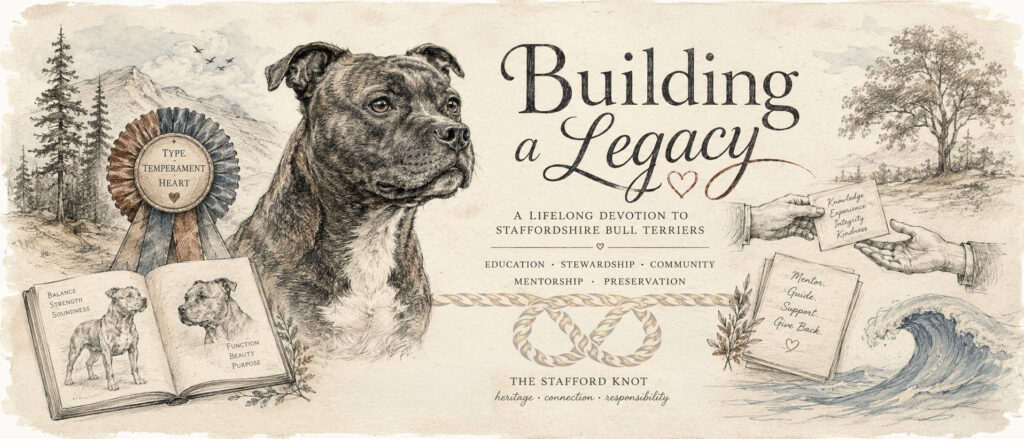
Legacy is built quietly over years. It is found in the dogs we preserve, the knowledge we share, the newcomers we encourage, the clubs we strengthen, the rescue dogs we help, the health research we support, the judges we educate, and the friendships we build along the way.
It is not measured only by ribbons or rankings. Records are broken. Great dogs eventually become memories.
What remains is what we gave back.
The Quiet Builders
If you’re new to this breed, take a moment to look around.
Every specialty show, every health clinic, every rescue fundraiser, every judges’ education seminar, every mentoring conversation, every illustrated booklet, every club newsletter, every trophy sponsor, every hospitality table, every educational display, and every historical archive exists because someone quietly gave their evenings, weekends, talents, and often their own money.
Most of those people will never receive public recognition.
Many won’t even be remembered by name.
Yet every new generation stands on the foundation they built.
Legacy is rarely built in moments of celebration.
More often, it is built on ordinary Tuesdays when no one is watching—when you choose to volunteer instead of spectate, to mentor instead of criticize, to create instead of complain, and to keep going when it would be easier to walk away.
Those moments rarely earn applause.
But they are the moments that shape the future of a breed.
More Than Breeding Dogs
Preserving a breed has never been only about producing beautiful dogs.
It is about producing better stewards.
Stewards who understand that preservation breeders should also strive to become historians, mentors, educators, volunteers, advocates, and caretakers of the breed’s future.
People who recognize that every generation inherits more than pedigrees. We inherit history, knowledge, traditions, responsibilities, and the work of those who came before us.
Our responsibility is not simply to preserve those gifts.
It is to add to them before passing them on.
Philosophies outlive people.
The Long View
Anyone who spends enough years in purebred dogs eventually learns that worthwhile work is rarely free of criticism.
Ideas will be questioned.
Projects will be criticized.
People will disagree.
Sometimes those disagreements become deeply personal.
It is easy to become distracted by conflict.
It is much harder—and much more valuable—to remain focused on building something that will still matter years from now.
The people who leave the greatest mark on a breed are rarely remembered because they won every argument.
They are remembered because they kept showing up.
They kept learning.
They kept giving.
They kept creating opportunities for others long after the excitement of the moment had passed.
Legacy isn’t about recognition.
Some of the most meaningful contributions are made quietly, without applause or acknowledgment.
Learning When to Say No
There comes a point in nearly every volunteer’s journey when they realize that legacy isn’t built by saying yes to everything.
It is built by learning what deserves your time.
What deserves your energy.
And sometimes, what deserves to be left behind.
Boundaries are not the end of service.
Often, they are what make a lifetime of service possible.
Choosing where to invest your heart allows you to continue giving where it matters most.
What Will Remain?
One day, someone new will discover this breed.
They won’t know every Best in Show winner.
They won’t remember every controversy or disagreement that once felt so important.
But they may benefit from a health initiative someone helped establish.
They may learn from a judges’ education program another volunteer created.
They may attend an event organized by people who simply wanted to bring the community together.
They may read an article that answered the question they didn’t yet know how to ask.
Or they may own a puppy whose pedigree reflects decades of thoughtful decisions made by people they will never meet.
That is legacy.
Perhaps the better question isn’t,
“What am I accomplishing today?”
Instead, ask yourself,
“What will still matter twenty years from now?”
Build dogs that improve the breed.
Build friendships that strengthen the community.
Build knowledge that others can inherit.
Build opportunities for those who come after you.
Leave the people you mentor stronger than you found them.
And above all…
Build things that outlive the criticism.