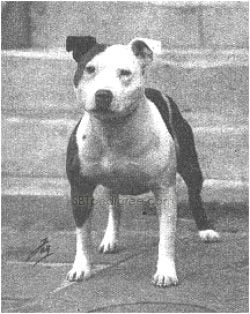
What Kind of Athlete Should a Stafford Be?
Running. Is it important?
It is an interesting question when discussing the Staffordshire Bull Terrier.
Should a Stafford be capable of running for an extended period of time?
I believe he should. But perhaps the better question is not simply how far can a Stafford run?
It is:
What kind of athlete was the Stafford originally intended to be?
The Stafford was not developed as a distance-running breed. He was not a sighthound bred to gallop across open country or an endurance trotter expected to cover miles behind livestock.
His historical purpose required a very different combination of physical and mental qualities: strength for his size, explosive power, agility, stamina, rapid recovery and an extraordinary determination to continue.
That history is reflected remarkably well in the written breed standard even today. The Stafford is described as well balanced, muscular, active and agile, and his movement should be free and powerful with economy of effort.
Those words are important.
Muscle was never supposed to replace athleticism.
Not a Marathon Runner
I have seen an interesting distinction in my own Staffords.
When allowed to exercise freely, they can travel for miles. They run, explore, stop when they choose, recover for a while, and then take off again. Given the opportunity, many will continue that pattern for a very long time.
They naturally regulate their effort.
Put those same dogs on a freely spinning slat mill and something different happens.
Instead of simply settling into one steady pace, they tend to produce tremendous bursts of speed, slow down or pause, and then explode again. Some will repeat that cycle far longer than I am prepared to allow them.
Eventually I stop them because their desire to continue can exceed the point at which I think it is sensible to allow them to continue.
That observation has made me think differently about the word endurance.
Historically, the Stafford’s work would not have resembled a steady five- or ten-mile run. The physical demands would have involved repeated periods of tremendous exertion: pushing, pulling, resisting, repositioning and explosive muscular effort, followed by opportunities—however brief—to recover before exerting himself again.
Some historical contests were prolonged affairs.
Whatever one thinks of that history today, physically it tells us something important about the animal that was required.
This was probably much closer to a repeated high-intensity athlete than a marathon runner.
The Engine, the Chassis and the Mind
For me, functional Stafford athleticism involves three interconnected things.
The engine is cardiovascular and respiratory fitness, muscular conditioning, temperature regulation and the ability to recover.
The chassis is sound construction and efficient movement. A dog that wastes energy through inefficient movement is working harder than a sound dog to accomplish the same thing.
And then there is the mind.
That may be particularly important in this breed.
The standard has long spoken of the Stafford’s courage and tenacity. Anyone who has lived with a highly driven Stafford understands that willingness to continue can be remarkable.
But there is an important distinction:
Determination and endurance are not the same thing.
A very determined Stafford may continue working despite fatigue. That tells us something about his mental character, but it does not necessarily tell us that his physical conditioning is adequate.
Conversely, a dog might possess excellent cardiovascular fitness but lack the desire to exert himself very hard.
The historical Stafford needed both.
The engine had to be capable.
The chassis had to hold together.
And the mind had to say, again.
Conditioning Matters
Natural athletic ability should not be confused with conditioning.
A genetically athletic Stafford that has spent months relatively inactive cannot safely be expected to suddenly perform prolonged strenuous exercise.
Conditioning has to be built.
Long walks, trotting, hill work, controlled running, swimming where appropriate, flirt pole work, treadmills or slat mills used responsibly, and modern performance sports can all play a role.
The exact activity matters less than the principle:
build gradually.
Duration increases.
Intensity increases.
Muscle strengthens.
Cardiovascular efficiency improves.
And recovery improves.
Rest days matter too.
So does body condition. An overweight dog carries unnecessary load during every step and has additional difficulty dissipating heat.
The goal of conditioning should never be to discover how exhausted we can make a Stafford.
It should be to increase the amount of work that Stafford can comfortably perform before becoming fatigued, and improve how efficiently he recovers afterward.
Recovery May Matter More Than Speed
Speed is easy to admire.
Recovery is much easier to overlook.
Yet I think recovery tells us an enormous amount about an athlete.
How quickly does the dog’s respiration begin returning toward normal?
How soon does he appear comfortable?
Does he remain coordinated as he becomes tired?
Can he resume activity after an appropriate interval without distress?
Does his breathing remain free?
Two dogs might produce equally impressive bursts of speed while having very different physical capacities.
One may recover quickly and be ready to work again.
The other may require considerably longer.
If we are talking about functional athleticism, that difference matters.
Perhaps we should be paying considerably more attention to recovery when evaluating the physical Stafford.
What About Muzzle Length?
This is where these conversations can become unnecessarily polarized.
Among my own Staffords, I have not seen endurance divide neatly according to whether the dog possessed a somewhat longer or somewhat shorter foreface.
Some of my most capable dogs have represented different head styles.
What I have noticed much more clearly are differences in conditioning, physical efficiency and particularly the individual dog’s mental willingness to keep going.
But this discussion needs an important qualification.
The Stafford breed standard calls for a short foreface. It does not describe a dog that should have difficulty breathing.
Those are two very different things.
Look at the historical dogs upon which our understanding of Stafford type was developed. We see powerful Stafford heads, broad skulls, pronounced cheek muscles and comparatively short forefaces—but we do not see a face shortened into the exaggerated form sometimes produced today.
Historical descriptions are equally instructive. Brindle Mick, the 1934 foundation sire of the influential M-line, was described as a powerful, substantial Stafford with a muzzle of “medium length and weight.” Although no known photograph of him appears to survive, contemporary writers noted that his general configuration was closely represented by his son, Ch. Gentleman Jim, for whom photographs do exist.
Brindle Mick’s son Brindle Bill was “somewhat shorter in face than his sire.” That tells us early Stafford writers themselves were recognizing variation in muzzle length within the breed—not treating the shortest possible muzzle as the automatic ideal.
This is where interpretation of a written standard matters.
A phrase such as short foreface should not be selected from the standard and exaggerated while everything surrounding it is forgotten.
The same standard describes an animal that must be active and agile. It asks for free, powerful movement with economy of effort. The current Royal Kennel Club standard also specifically calls for open nostrils.
These qualities must exist in the same dog.
Correct Stafford type should not require impaired respiration.
BOAS and the Stafford
BOAS—Brachycephalic Obstructive Airway Syndrome—is a real condition involving anatomical airway obstruction.
It deserves discussion in Staffords precisely because we should never normalize abnormal breathing in our breed.
But care is required here.
A Stafford should not be presumed to have BOAS simply because he is a Stafford, nor should noisy or restricted breathing be accepted as an inevitable consequence of correct Stafford type.
The written breed standard does not describe a dog that should struggle to breathe.
BOAS should be considered when an individual dog displays signs such as persistent respiratory noise, excessive respiratory effort, poor exercise tolerance, abnormal recovery or other evidence of airway obstruction.
Breeders should take those things seriously.
At the same time, we should be very careful about allowing disease terminology to redefine correct breed type.
If exaggeration of the Stafford head eventually produces impaired respiratory function, the answer is not to declare that impaired respiration is inherent to being a Stafford.
The answer is to recognize the exaggeration.
Correct type and correct function should reinforce one another.
A characteristic Stafford head belongs on a dog capable of behaving like a Stafford.
Heat, Drive and Knowing When to Stop
There is another reason breathing and recovery matter: heat.
Dogs depend heavily upon respiratory evaporation through panting to lose heat. Hard exercise produces considerable heat, and warm temperatures or high humidity make cooling more difficult.
Every Stafford owner conditioning a dog should understand that athletic drive can occasionally work against self-preservation.
The highly determined dog is not necessarily going to make the sensible decision for himself.
Mine have demonstrated that very clearly.
A dog that wants to keep going is telling us something interesting about temperament.
It is not giving us permission to abandon judgment.
Weather matters.
Humidity matters.
Body condition matters.
Fitness matters.
Age matters.
Hydration matters.
And the individual dog matters.
Exercise in warm conditions should be modified accordingly, with access to water, shade and appropriate opportunities to cool and recover.
Heavy or unusual panting, excessive drooling, weakness, poor coordination, disorientation, vomiting, collapse, or a dog that simply is not recovering normally are not demonstrations of Stafford courage.
They are reasons to stop.
Mental determination should never be mistaken for physiological invincibility.
Preserving the Athlete
Perhaps this is where the discussion ultimately leads.
We obviously no longer ask the Stafford to perform the activity for which some of his ancestors were originally developed.
But preservation breeding means understanding the characteristics that history created rather than merely preserving a silhouette.
The historical Stafford required considerably more than a large head and heavy muscle.
Strength without agility would have been a disadvantage.
Power without stamina would have been a disadvantage.
Determination without physical capacity would have been a disadvantage.
Inefficient movement would waste precious energy.
Poor recovery would matter.
Compromised respiration would matter.
The complete animal required strength, agility, physical endurance, efficient recovery and tremendous mental determination.
Today we have infinitely better ways to allow those qualities to express themselves.
Staffords can hike, run, swim, participate in agility, Fast CAT, weight pull, scent work, obedience, rally and countless other activities. Or they can simply spend a day doing what Staffords have always enjoyed doing—using their bodies enthusiastically.
So, is running important?
Yes.
A Stafford should be physically capable of running.
But I don’t believe the number of miles a Stafford can travel tells us nearly as much as people sometimes think it does.
I would rather ask:
Can this Stafford use his body powerfully and efficiently?
Can he produce intense effort and sustain repeated effort?
Can he breathe freely?
Can he recover efficiently?
Is his structure sound enough to perform the work his mind wants to do?
And when he has recovered, does that unmistakable Stafford mind say:
Let’s go again.
That, to me, is a much more meaningful picture of Stafford athleticism.