Judges Are People Too
Recently I have noticed a familiar little comment appearing beneath photographs from specialties.
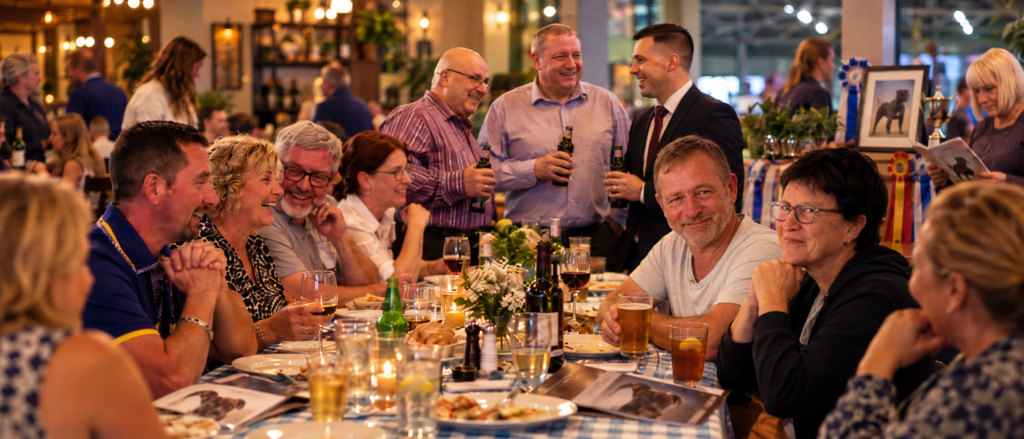
A group of Stafford people is sitting around a table after the show. Maybe they are having dinner. Maybe someone has a cocktail. Maybe a visiting judge is sitting among them, talking dogs, laughing and enjoying the weekend.
And inevitably someone writes something along the lines of:
“Oh, I see you’re fraternizing with the judge! LOL!”
Usually followed by enough laughing emojis to make it supposedly harmless.
It isn’t particularly funny.
More importantly, comments like that casually call into question the integrity of the judge and create suspicion around something that should be one of the nicest parts of our breed community.
There are, of course, rules and ethical boundaries surrounding judges and exhibitors, and there should be.
A judge should never be placed in a situation where someone is attempting to influence an upcoming decision. Exhibitors should not spend the weekend promoting their dogs, discussing what they are entering, campaigning their breeding program or creating circumstances that could reasonably make others question the judge’s impartiality.
Judges have responsibilities here as well. AKC guidance specifically addresses inappropriate social contact and repeated socializing with exhibitors entered under a judge during the same weekend, circuit or cluster.
That deserves to be taken seriously.
But AKC guidance also recognizes something that sometimes gets lost in all this: judges may attend club dinners and other social functions where exhibitors are present. The expectation is simply that appropriate boundaries are maintained, particularly with anyone who may appear in that judge’s ring.
There is an enormous stretch of perfectly normal human interaction between improper influence and pretending the judge does not exist until judging begins.
And somewhere along the way, I think we have lost sight of that.
And What Happened to the Judge’s Liaison?
This is also why I think the role of the judge’s liaison deserves more attention than it sometimes receives.
A liaison is not simply the person who collects a judge at the airport, deposits them at a hotel and makes sure they appear at ringside at the correct hour.
That is transportation.
Hospitality is something more.
Particularly at a specialty—and especially when we have invited someone from another country—the liaison should be the judge’s point person for the weekend.
Make sure they know the schedule.
Make sure they know where they need to be and when.
Help them understand what they may appropriately watch and what they should avoid. AKC guidance, for example, says judges should not observe the judging of a breed they are scheduled to judge later during that weekend or cluster.
That is exactly the sort of thing an attentive liaison can help navigate.
But beyond the rulebook, there is simple hospitality.
Does your guest know where to get coffee in the morning?
Have they had breakfast?
Does someone know whether they need lunch?
Would they like a beer after the show?
Is there another breed or group they would enjoy watching when it is appropriate to do so?
If there is an afternoon free, would they enjoy seeing something distinctive about the area rather than staring at four walls in a hotel room?
Take them sightseeing.
Show them your city.
Introduce them to people they are free to meet.
Sit down over dinner and talk about dogs, history, travel, families, gardens, weather, whatever human beings happen to talk about.
Entertain your guest.
That does not mean campaigning your Stafford.
It means being a gracious host.
And this is precisely why, whenever possible, the person serving as liaison should not be exhibiting to that judge. It gives the liaison the freedom to concentrate on the assignment without creating unnecessary awkwardness or questions about motive.
It also allows the judge to relax.
We invited this person.
They may have traveled thousands of miles, crossed several time zones and given up a substantial portion of their week to come give us the opinion we requested.
Surely we can do better than:
Here is your hotel key. The shuttle leaves at 7:15. See you tomorrow.
When a club invites a judge—particularly someone who has traveled halfway across the country or across an ocean—we have invited a guest.
They should feel welcome.
Use common sense.
Don’t bring your dog over for an informal examination.
Don’t spend dinner explaining why your bitch should win tomorrow.
Don’t give the judge the genealogy of everything you have bred since 1997.
Don’t monopolize them all weekend if you are entered under them.
And certainly don’t put a judge in a position that could reasonably compromise—or appear to compromise—their impartiality.
But please don’t leave someone sitting alone in a hotel room because everyone is terrified somebody on Facebook might post a snarky comment.
There is another piece of this that bothers me.
Those jokes aren’t only aimed at exhibitors.
They insult the judge.
The implication is that sharing a meal, a laugh or a conversation with someone might somehow purchase their opinion the following day.
If we believe so little in the integrity of the people we invite to judge our dogs, perhaps we have a much larger problem than who sat beside whom at dinner.
Personally, I see judging as a responsibility I have been hired to perform.
When I walk into the ring with the judge’s book and you bring me a Stafford to evaluate, I am your judge.
For those few minutes, my responsibility is very simple: evaluate what is in front of me and make my decisions on the merits of the dogs.
That responsibility and the ethical obligations surrounding it obviously extend beyond the physical boundaries of the ring. We have rules for a reason.
But having a judging assignment does not erase the rest of who I am.
I am still a Stafford enthusiast.
Someone who loves talking about this breed.
Someone who enjoys old photographs, pedigrees, history, funny dog stories, good conversation and spending time with other people who somehow decided that traveling ridiculous distances to stand around discussing Staffords was a perfectly reasonable way to spend a weekend.
Having a judging license doesn’t erase that.
I also have a driver’s license.
Nobody looks across the dinner table and thinks, There sits a motorist.
Context matters.
So does common sense.
Perhaps we could extend a little more of both to one another.
Specialties should be about more than ribbons. They are one of the increasingly rare opportunities we have to gather as a breed community—to learn from one another, renew friendships, welcome visitors and spend an entire weekend among people who understand why we care so deeply about these dogs.
Protect the integrity of judging.
Absolutely.
Respect appropriate boundaries.
Of course.
But let’s stop manufacturing scandal where none exists.
And while we’re at it, let’s remember what it means to host someone properly.
Welcome our guests.
Feed them.
Show them around.
Include them.
Let them enjoy the weekend.
Talk Staffords when it is appropriate.
Talk about everything else when it isn’t.
Laugh.
Have dinner.
Have the beer.
And remember why we all came in the first place.
The dogs.